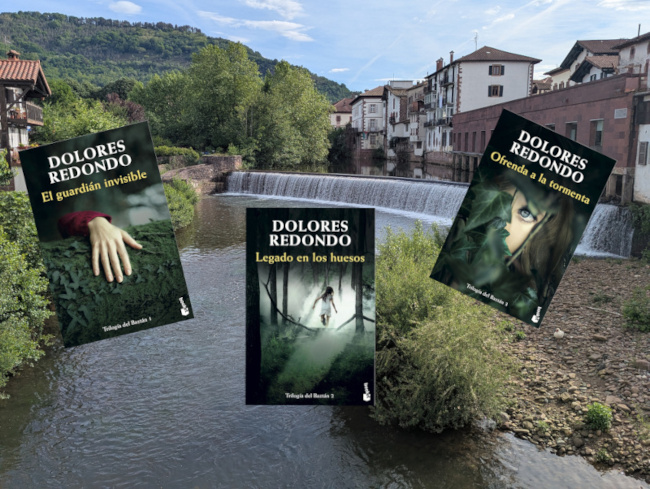
Some books make you want to hit the road. The Baztán Trilogy is one of them: barely closed, it sends the reader looking on a map for the valley in Spain’s Basque Country where the whole story unfolds. Novels, film adaptations and the real landscape mirror one another so closely that visitors can sometimes be spotted in the streets of Elizondo, book in hand, tracking down places they first discovered on the page.
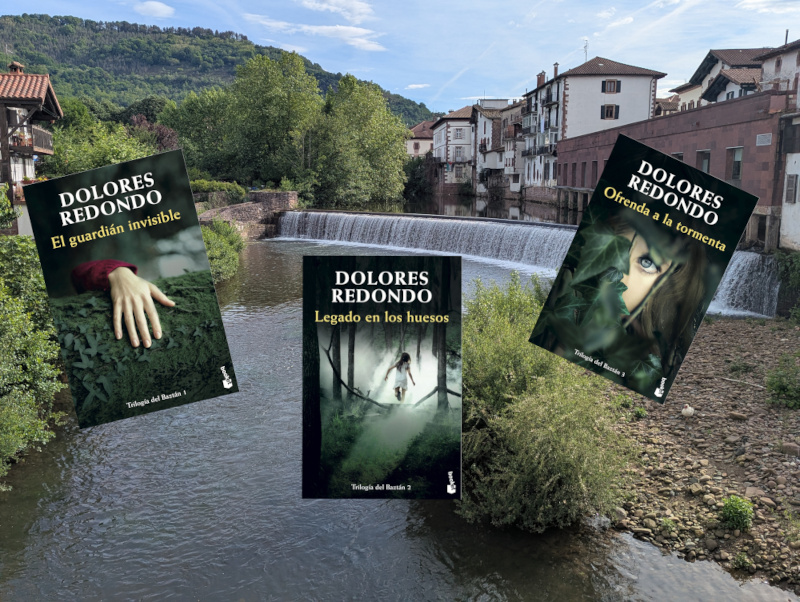
Dolores Redondo‘s central work consists of three novels that make up the Baztán Trilogy: The Invisible Guardian (2013), The Legacy of the Bones (2015) and Offering to the Storm (2016). It later grew with three further books: The North Face of the Heart (2019) and Awaiting the Flood (2024), which take place chronologically before the trilogy, and Those Who Don’t Sleep (2024), which follows on from it.
Do not miss the Baztán and Elizondo photo gallery!
A more in-depth study of this work is availaible in PDF format.
The novels and their adaptations
An inspector with the Navarre regional police, Amaïa Salazar is the only woman leading a team in a man’s world, one that must learn to respect her. Around her orbit a wide range of male characters, far from the classic tough-guy detective, alongside striking female figures: her sisters, her aunt Engrasi, and many other women whose paths form the true heart of the saga. Amaïa herself carries a personal history far older than her investigations, one the trilogy takes care to reveal only gradually.
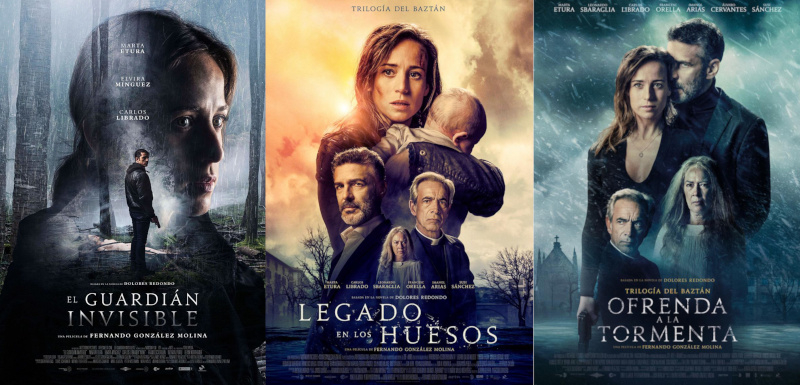
The first three novels were adapted for the screen between 2017 and 2020, with Marta Etura playing Amaïa. The films are visually striking, with a strong sense of atmosphere and setting, but they take significant liberties with the novels, narrowing the plot to its crime-thriller side at the expense of its mythological depth. That alone makes it worth comparing the two versions — as long as you start with the books.
What truly sets this saga apart is the way it weaves the police investigation together with ancestral Basque beliefs: the Basajaun, invisible guardian of the forest, the goddess Mari who presides over storms, the witches of the Baztán valley, and many other traditional figures. Dolores Redondo, who describes herself as “a writer of storms,” builds a world in which the ancient and the contemporary constantly answer each other.
It is precisely on this ground that the trilogy becomes most compelling to question, beyond the crime plot itself: the ground of a philosophical inquiry that runs through the whole work without ever settling on a single answer.
The Baztán: Monsters and Gods
The central question might be put this way: do monsters and gods exist independently of our beliefs, or is it our beliefs that bring them into existence? In other words, when a people shapes figures like the Basajaun or the goddess Mari over centuries, are these merely cultural representations, convenient ways of narrating the inexplicable — or do they touch something genuinely present in the world, which culture simply gives a name to?
This dilemma is not unique to the Basque Country or to Dolores Redondo’s fiction. It has long run through any reflection on phenomena that reason struggles to fully explain.
- Pure effect of a cultural framework, which shapes in advance what each person perceives and believes they recognize?
- Internal origin within the human mind, capable on its own of producing visions, terrors and outbursts of violence, with no need for any outside force to intervene?
- Part of the reality that ordinarily escapes our senses, rather than being mere constructions of the mind or of culture? Does certain experiences give genuine access to this?
Dolores Redondo never explicitly picks a side among these three readings, and that is precisely what makes her work so rich. She stages characters who embody each of these positions: rational investigators who initially dismiss any supernatural explanation as pure superstition, religious or scientific figures who flatly oppose a purely psychological explanation of evil, and events that nothing rational seems able to fully account for. The reader is thus left facing a question the fiction never closes off: should we look, behind behaviour and deaths that seem to defy all ordinary logic, for an explanation reducible to individual psychology and social context — or should we accept that a force older and larger than any single human mind might genuinely be at work?
Personal identity, collective memory, and freedom
This question leads to a second, equally central one: how much freedom is left to a human being caught up in a force beyond him, whether it is called a destiny, a curse, a collective memory, or a psychological grip? Many characters in the trilogy carry within them a history, a lineage or a context that seems to have shaped their fate long before they could choose anything at all. The question of free will runs through the whole story: are we responsible for what we become when our personal, family or cultural history seems to have prepared us for it long in advance? Can we speak of genuine guilt, or only of a destiny fulfilled, when someone carries out what their past already seemed to have written into them? The trilogy offers no single answer: it shows trajectories in which individual responsibility and the weight of a history larger than the individual remain forever intertwined.
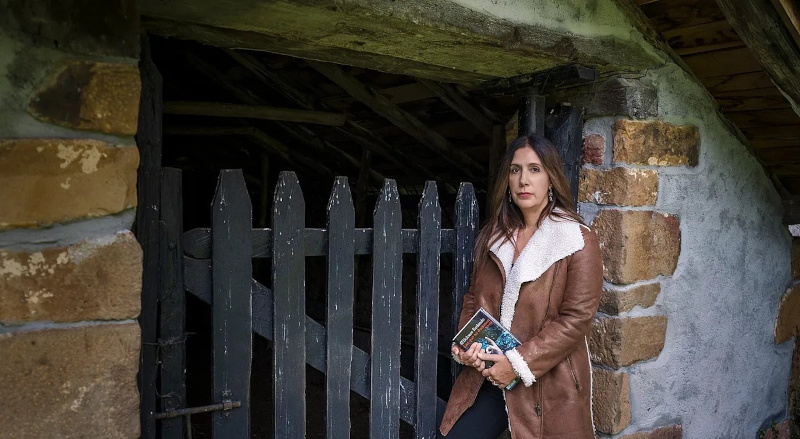
There is, finally, a broader anthropological dimension to this reflection, one that reaches beyond the Basque setting alone. Dolores Redondo questions the very notion of collective memory: certain places, practices and beliefs seem to pass down through generations with a force that exceeds mere cultural habit, as if very old patterns kept acting on people’s minds without anyone being clearly aware of it. Some thinkers have perceived, at work in all human cultures—beneath their apparent differences—a collective unconscious: a shared foundation of images and figures lying at the very core of our being.By choosing to root her story in one specific region, with its own legends, while hinting that comparable phenomena exist elsewhere under other names and within other traditions, the author suggests that the problem she raises is less Basque than human: what do our cultures make of fear, evil and the inexplicable — and what, in turn, do these constructions make of us?
This is where the Baztán Trilogy moves beyond a regional crime series to become a genuine inquiry, carried by a gripping plot and a strong sense of place. The reader who follows Amaïa Salazar through her long journey, from an outspoken rationalism to an ever more intimate confrontation with what she first dismissed as superstition, is invited to ask the question for themselves, with no final answer imposed on them.
A more in-depth study of this work, covering the characters, the film adaptations and the full range of these philosophical questions in detail, is available for readers who have already finished all six novels. This full study reveals key elements of the plot and is therefore intended only for those who have closed the books. It is availaible in PDF format:
 Version Française | English version |
Do not miss the Baztán and Elizondo photo gallery!